









Icon Layer
The Icon Layer facilitates the placement of custom visual markers across geographic coordinates, enabling administrators to represent distinct data categories or status thresholds using instantly recognizable symbols. When monitoring complex, multi variable environments on a central operations video wall, replacing standard data points with specific icons allows teams to immediately parse different data classes such as asset types, alert severity, or facility statuses without needing to process raw text. By segmenting datasets through property filters and applying distinct symbols to separate layers, users can construct highly readable, symbol driven map visualizations complemented by fully customizable typography settings to ensure optimal legibility at any distance.
Once your data is loaded into a layout, the Icon Layer Settings will appear in the Settings tab.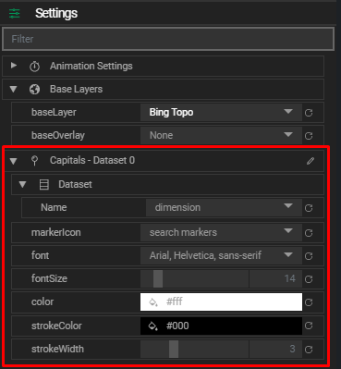
How to Visualize Icon Markers
- In the Dataset Settings, select the Name field.
- This determines the text label shown next to each icon.
- Choose your Marker Icon from the available options.
Your icons will now be visible on the map at the corresponding coordinates.
Example Use Case
In the example below, we visualized capital city populations using two filters:
- Cities with a population over 2 million
- Cities with a population under 2 million
Each filter was assigned a different icon, and both were added as separate Icon Layers.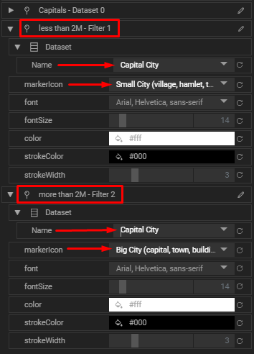
Icon Layer Settings
You can customize how your icons and their labels appear:
- Font – Font family used for the title (label) text.
- Font Size – Size of the label text.
- Color – Color of the label text.
- Stroke Color – Outline color around the text.
- Stroke Width – Width of the outline.
Tips
- Combine Icon Layers with Filters for more detailed visualizations (e.g., different icons for different thresholds).
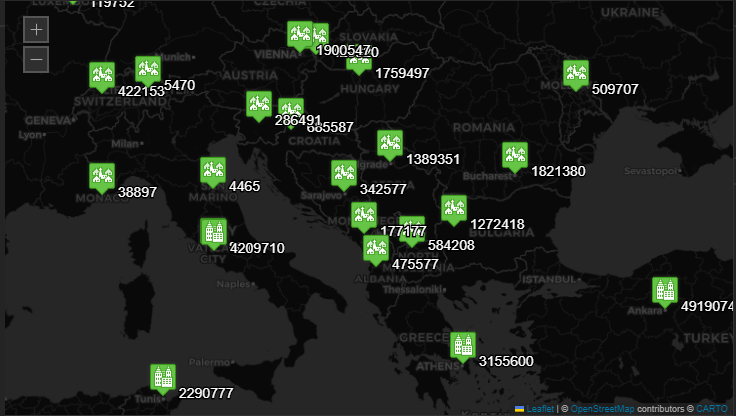
We are visualizing population data with different Icons according to populations on the capital cities.